Resilience and Leadership

[This is part of an occasional series about the characteristics of intercultural leaders.]

ResilienceIn times of trial and uncertainty we turn to our leaders for calm. When leaders aren’t calm, how can the rest of us be?

I once worked in an organization facing severe financial strain. Everybody knew we were under pressure, but we were okay, because every time news came, good or bad, our leader would confidently say “The future is bright!” He had the technical skills to guide the organization through the challenges, so we knew his words weren’t hollow. It just meant so much to us that our leader was solid in his belief that we would all be okay. Morale remained high, despite our challenges.

Continue reading

Posted in Center for Intercultural Leadership (CIL) | Tagged , , | Leave a comment

Vision, Legacy and Innovative Partnership Provides a Gateway for Graduate Students at I-House

Bonnie-Students

Bonnie Johnston (center) with scholarship recipients. Bonnie manages the Financial Aid program and considers it a “labor of love.”

For a dozen years, International House at UC Berkeley has been at the helm of a unique and innovative venture, The Gateway Fellowship Program. This unique partnership is between donors to I-House, the UCB Graduate Division and academic departments of UC Berkeley.

Seen as an opportunity to support top incoming graduate students from diverse backgrounds with financial need, and to compete for the best and the brightest to choose UC Berkeley, generous donors joined forces with I-House to establish endowment funds for this very purpose. With appreciation to these donors, the former deans of the Graduate Division and I-House staff, we are pleased to offer a competition for up to ten such fellowships for the 2015-2016 academic year. Continue reading

Posted in Faces of I-House, Life at I-House | Tagged , , , | 1 Comment

Film Series: “Rediscovering Pakistan: The Untold Tale”

The I-House Spring 2015 Film Series begins tonight with a screening of Rediscovering Pakistan: The Untold Tale at 7 pm in the I-House Home Room. The filmmaker, Moin Khan, will present the film with a discussion following the screening. Refreshments provided. Continue reading

Posted in Upcoming Events | Tagged | Leave a comment

What is intercultural competence? Part 1

Fu_Intercultural_Competence_TP_WC_600Much of the work we do at the Center for Intercultural Leadership (CIL) revolves around developing something called “intercultural competence.” What is it?

In simplest terms it means our ability to work well with people from different cultural backgrounds — meaning different patterns of thinking and behaving. For example, my upbringing in the U.S. trained me to speak my thoughts directly to my colleagues. What happens if my company sends me to work in a country where words convey a smaller part of the overall message, and I’m expected to read other, non-linguistic cues to get the full message? This is a very real work challenge faced every day all over the world. How I respond is going to have a big impact on my effectiveness — and depends a lot on my level of intercultural competence. Continue reading

Posted in Center for Intercultural Leadership (CIL) | Tagged , , | 1 Comment

Jan 19-25 Menu + MLK Holiday Brunch today: 9:30am-1:30pm

As a reminder, I-House Dining Services will be temporarily located at the Field Club in the stadium for the spring semester for the Dining Commons Transformation Project. Continue reading

Posted in What's Cooking | Tagged , , , , , , , | Leave a comment

Time to talk our way through the Charlie Hebdo attack

One week after the Charlie Hebdo assault in Paris I am still feeling upset, angry and hopeless about what happened. I have been a journalist for so many years, I am very familiar with the work of my French colleagues at Charlie Hebdo and, during one trip to Paris, I even visited the place they used to work, their bureau, la rédaction.

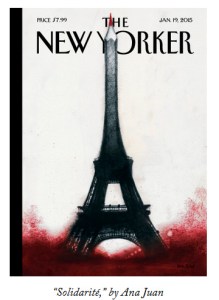
The New Yorker Magazine coverI can’t stop thinking of my friends journalists back in Rome, in my mind I have replayed our weekly meetings hundreds of times and I have been obsessively following the news from the moment this all started as I used to do when I was a reporter.

Emotions are not good companions when you try to deal with such a complicated and delicate story as the Charlie Hebdo one. So I have been patiently waiting to feel better and be able to think about this and understand. Yet, I can’t let it go. The struggle to understand what happened has soon become the struggle to understand how to personally deal with this in first place, how to explain it to myself and to my sons who in the past days have seen my husband and me watching TV news and talking about Paris, terrorism, France, the banlieues, Pakistan, Nigeria and Boko Haram. Continue reading

Posted in Life at I-House | Tagged | Leave a comment

Gaining Global Leadership Skills While Building Deep Friendships

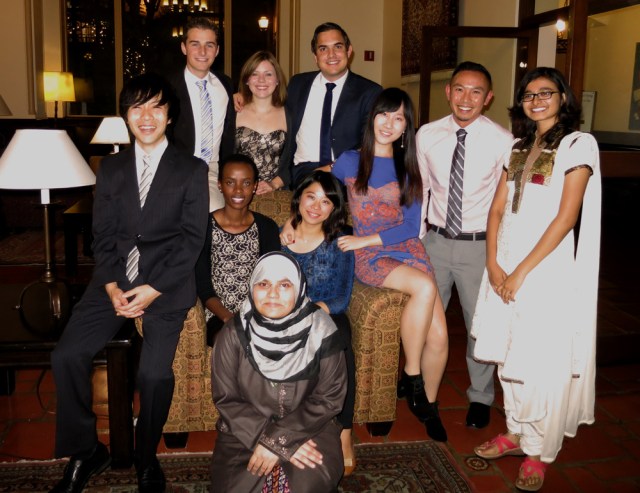
The Intercultural Leadership Initiative (ILI) is a once in a lifetime opportunity for I-House residents and student staff.  Imagine a room full of young leaders from around the world thinking about how to be a more effective leader in today’s complex and diverse world while sharing openly about their unique stories and cultural backgrounds? This is a part of what is so special about the ILI experience.

ILICelebration2014

The Intercultural Leadership Initiative cohort for fall semester 2014 celebrated graduation with a festive dinner banquet in the Home Room on December 9, 2014. ILI certificates were presented by Hans Giesecke, I-House Executive Director, and Jess Delegencia, ILI Coordinator.

Continue reading

Posted in Center for Intercultural Leadership (CIL), Intercultural Leadership Initiative (ILI) | Tagged , , , , | Leave a comment

Empathy: An Anchor in the Storm

empathyWords fail me — fail all of us, really — in the flurry of awful emotions after the violence in Paris last week. Speaking just for myself, I can’t possibly get my mind and heart around the horror of the reality that innocent people were systematically murdered for publishing cartoons. I suspect that many of you reading this post feel the same way. What I’m finding, though, is that beyond this reaction there is much territory for us to explore.

Many media commentators have weighed in on the matter. Every author I’ve read agrees that what happened is horrific. Beyond that there is little agreement. Arguments swirl around many questions, including the poverty and exclusion of Muslim communities in France (and more broadly in Europe); the legacy of colonialism; the sanctity of free speech as a universal value; the quality and intent of the work published in Charlie Hebdo (and whether or not it matters). And many, many more questions.

My head is spinning, and I have been trying to find somewhere to anchor myself in sorting through all the words I have been hearing and reading. I would like to offer you something that I hope will help you if you are struggling with this, too.

On Friday evening I heard some words from U.S. Secretary of State John Kerry on the radio. He said a lot of positive things, and even delivered a portion of his speech in French — a rare and meaningful effort from a high-ranking American official.

At one point he said the following:

Today’s murders are part of a larger confrontation, not between civilizations — no — but between civilization itself and those who are opposed to a civilized world.

As I listened I had two reactions in rapid succession. First, I could feel pride welling up inside of me — the pride of defiance, like a mental fist-pump: “Yeah! You tell ’em, John!”

Right after that, though, I had a different thought: Really? Is that a useful thing to say? Does it help us move forward in a meaningful way — or, more to the point, in a way that promotes peace, understanding, and compassion?

In other words, if we collectively act in the spirit of these words, what kind of a future can we expect for the world? My answer is: not one that seeks to bridge such sharp divides among people.

I believe this portion of Secretary Kerry’s remarks is misguided, because it succumbs to the same temptation that has steered humanity wrong throughout our entire history, and which has been and will continue to be the main source of bloodshed in our species: the temptation to dehumanize, demean and separate rather than find commonality and kinship of purpose.

At first glance “dehumanize” may seem a bit strong, and maybe even inaccurate. If not fully dehumanizing, the words at least point in that direction: If “they” are “opposed to a civilized world,” then who — or what — are they? Are they even human? The words at least leave open the possibility that they aren’t fully human, and thus “we” are clearly superior to them.

Dehumanizing is a natural thing to do, especially when we feel under threat. So I’m not surprised that John Kerry, as a human being, would dehumanize, just as we all do in our weaker moments. Secretary Kerry is also a political figure, and is expected, at times such as these, to “circle the wagons” — to solidify who “we” are, and what “we” stand for, as a way of making meaning out of tragedy.

The problem is that dehumanizing always leads us astray. If we wish to close the gaps that separate us, and to cut the ropes that bind us to hatred and distrust, then we need to try harder. We need to do the real, deep, and challenging work of examining our own biases — and, as part of that process, to try, impossible as it may seem, to see things as others might see them. When these “others” are murderers, then this becomes some of the most challenging work there is. But it doesn’t let us off the hook. If we want a peaceful world, we simply have to try and understand the motives of those whose actions we find so incomprehensible.

If you have 18 minutes to spare, I strongly recommend this brilliant TED talk by Penn State Professor of Sociology Sam Richards, entitled “A Radical Experiment in Empathy.” He expertly guides us through what such an exercise could look like.

My encouragement to all of us is to challenge ourselves, through this difficult time, to keep a mental ear out for our tendency to dehumanize, and to fight it with the most powerful antidote we have: empathy. Let’s seek out knowledge about those we understand least well, even those we fear the most, and try as hard as we can to understand how and why they see the world so differently than we do.

I think many of us fear doing this because we are afraid that if we can understand evil, we will become evil. Or, that in order to see things from a deeply different perspective, we must give up something about who we fundamentally are. I also believe that this fear is unfounded: if we are brave enough and persistent enough, we have the capacity to understand, and to do so while remaining true to who we are and what we believe.

If each of us — day by day, year by year, generation by generation — does this “impossible” work with ourselves, I believe we will see a world with far less bloodshed and suffering.

Here at International House we are engaging in a number of conversations about how we can best support our residents, along with other members of the UC Berkeley community, during such difficult times in the most impactful ways we can. We welcome your ideas and suggestions.


Posted in Center for Intercultural Leadership (CIL) | Tagged , , | 1 Comment

January 13-18 Menu – Stadium Field Club now open!

As a reminder, I-House Dining Services will be temporarily located at the Field Club in the stadium for the spring semester for the Dining Commons Transformation Project.

Menu Jan 13-18View weekly menu at: http://ihouse.berkeley.edu/dining/menu.php

Got questions?  Below are a few helpful tips from our Frequently Asked Questions page.

Where is the Field Club and how do I get there from I-House?

The California Memorial Stadium Field Club is located next to International House. There will be an additional temporary exit on Bancroft Way for residents during the construction period. See map with routes highlighed below:

Map to Stadium Field Club


Will the dining hours at the Field Club be the same as they are at I-House?

Yes – opening and closing hours will be the same:

Monday – Friday
Breakfast 7:15 – 9:30 AM
Lunch 11:30 AM – 1:30 PM
Dinner 6:00 – 8:00 PM
Saturday & Sunday

Brunch 9:30 AM – 1:00 PM
Dinner 6:00 – 8:00 PM


Will we still be able to use our Café Flex Dollars at the I-House Café while the dining room is at the Field Club?

Yes – The Café will be open as usual and your Café points will be accessible there as they were in the Fall semester.


Will we receive some extra Café Flex Dollars for the Spring semester?

Yes – residents at I-House for Spring 2015 will receive additional Café points for the Spring semester so you can get something to-go at the Café if you don’t have time to go to the Field Club in the morning or anytime. The exact amount will be made available when the Spring Café balances are loaded.

Will the food at the Field Club be prepared and served by I-House staff?

Yes – the Dining Services team will move to the Stadium Field Club for the renovation period, so you will see the same faces preparing and serving your food, as you see at I-House in the Fall.

Will we still have Theme meals like Chinese New Year, when we are in the Field Club?

Yes, we will be serving theme meals, your favorites from Fall, as well as some special surprises, so your experience at the Field Club is as fun and exciting as it can be, to match the special place where you will be dining daily – California Memorial Stadium!

Will the campus community be able to dine in the Field Club with I-House residents?

Yes, we expect to be open to the public at the Field Club, just as we are at I-House.

For more Q & A on the Dining Commons Transformation Project, visit our FAQ page.

Posted in What's Cooking | Tagged , , , , , , | Leave a comment

The Power of Humility

[This is part of an occasional series about the characteristics of intercultural leaders.]

HumilityHaving spent ten years as a U.S. American living and working in China, I’ve been lucky enough to have had many, many chances to reframe intercultural challenges by using humility. Here’s one example from my most recent role, as American Co-Director of the Hopkins–Nanjing Center for Chinese and American Studies.

Our staff at the Center consisted of both Americans and Chinese. Mostly the staff functioned as one integrated unit, but I also had a special set of relationships with my American staff. At one point I decided to hand a project over to one of them: she was extremely bright and capable, and I knew she’d do a great job. As the weeks passed, I began to get negative feedback from my Chinese colleagues about the arrangement. At first I dug in my heels: how dare “they” interfere with “my” staff? Slowly, though, I began to identify my assumptions: the right way to do things is to empower capable staff to take on projects and to run with them. What I hadn’t recognized at first was (a) that these were my assumptions, and (b) that these assumptions are deeply and thoroughly American, and aren’t appropriate for a Chinese work environment, which tends to be far more interdependent and hierarchical. (One of the main complaints I’d received was that it wasn’t “appropriate” for someone of this staff member’s low position in the organization to take on so much responsibility).

For a while I clung to the belief that the “American way” is still better, and that I was sacrificing something by “tolerating” the “Chinese way.” Soon, though, it became clear to me that all in all, inside of the larger cultural and organizational environment, the more interdependent and hierarchical approach was actually a lot more appropriate — and, crucially, more effective.

Leaders face all manner of obstacles in culturally complex environments. Our home cultures provide us with many resources for overcoming obstacles — including a sense of self, which is shaped by the values of our home culture.

The problem is that when we encounter cultures with different values, our sense of self — our ego — can feel threatened. And when we feel threatened, we literally can’t think straight: our higher brain functions are inhibited by the activation of the “fight or flight” response. And if we can’t think straight, how can we lead effectively?

At times like this humility can be the leader’s best friend. It’s one thing to feel like it’s “us” against “them,” and that if “they” win, something bad will happen to “us.” It’s quite another thing to see our own world view as just one of the world’s countless ways of thinking and doing. Humility reminds us that the world is a large and complex place — a rich place — and “my” way is just one way. The “strange” and “maddening” habits of “others” that are unfamiliar are transformed into a smorgasbord of options for solving problems. Problems might even cease to be problems in the eyes of the intercultural leader: they are, instead, opportunities to learn, and to expand our repertoire of ways of seeing and responding to the world.

In the story I shared above, it took a good dose of humility to get there, but I got there, and became a better leader for it.

In our most difficult intercultural moments, when the “other” culture seems most bizarre and just plain wrong, our egos will try their hardest to inflate themselves. Our lives at International House offer us so many opportunities, each and every day, to examine our most firmly held views, and how these might be distancing us from others. Intercultural leaders will be ready to meet the challenge: to rise above the ego’s distractions and keep everyone moving forward toward common goals.


Posted in Center for Intercultural Leadership (CIL) | Tagged , | Comments Off on The Power of Humility